

What if the best perfume isn’t the one topping a list, but the one that still feels right after it settles? Rankings can point you toward a style, but they can’t tell you how a fragrance will develop on your skin or suit the moments you want it for. The opening is only the first impression.
To choose well, consider the whole composition: how its notes shift, how its concentration shapes the experience, and whether its presence suits your routine or a particular occasion. This guide shows you how to assess a fragrance beyond popularity, follow its evolution from first spray to dry-down, and compare options with more confidence. You’ll learn what to notice, what fragrance language can tell you, and how to recognize a scent that feels distinctive without feeling borrowed.
Key Takeaways
- Define the best perfume by how its scent profile, development on your skin, and setting suit you, not by its place on a ranking.
- Compare fragrances by testing them on skin and noticing how the opening changes as the scent settles.
- Match a fragrance’s presence to your routine, whether you want it for everyday wear, evening occasions, or both.
- Explore distinct note profiles, such as the coffee and spice of Secret Weapon or the davana and pink pepper of Fortune Teller, to clarify what resonates with you.
What Makes a Perfume the Best? Start with Fit, Not Rankings
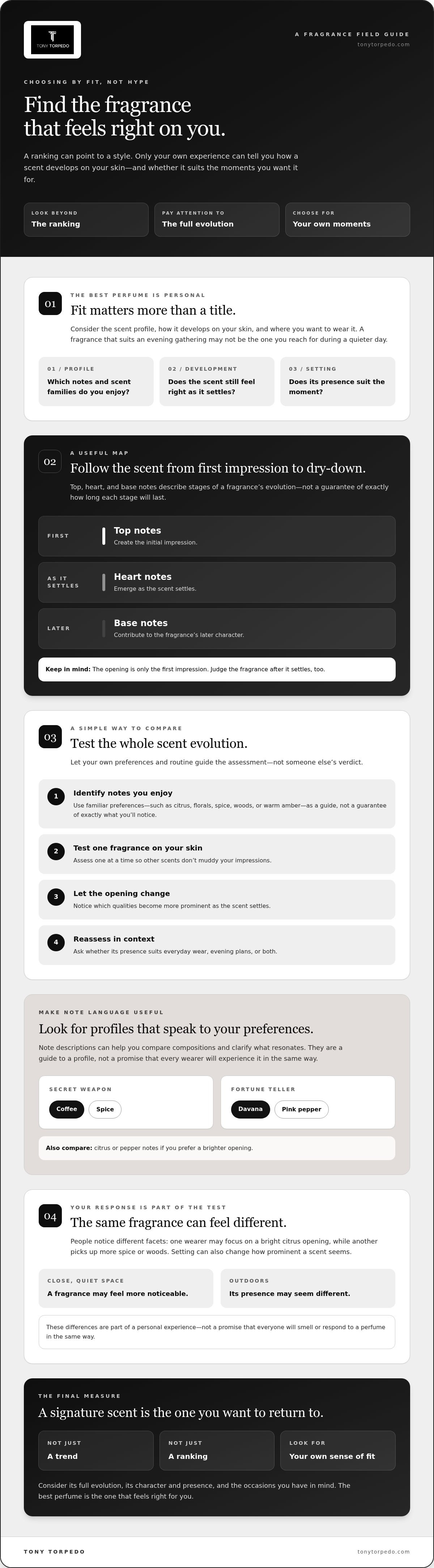
The best perfume is the fragrance that feels right on you, from its first impression to its settled character, in the moments you want to wear it. No ranking can determine that for everyone. Start with the scent families and notes you tend to enjoy, then think about when and where you want to wear the fragrance. A scent that suits an evening gathering may not be the profile you reach for during a quieter day.
A perfume’s opening is only the beginning. As it develops, different facets come forward, so a first impression may not reflect the scent you’ll experience later. For a broader overview of the history and composition of perfume, including how fragrance notes are described, see this reference.
For another perspective on choosing and wearing fragrance, watch this video:
Why the same perfume can feel different from person to person
People notice different parts of a fragrance. One wearer may focus on a bright citrus opening; another may pick up more spice or woods. The setting can also affect how prominent a scent seems. A fragrance may feel more noticeable in a close, quiet space than outdoors. These differences are part of a personal experience, not a promise that everyone will smell or respond to a perfume in the same way.
Top, heart, and base notes offer a useful map of that evolution. Top notes create the initial impression; heart notes emerge as the scent settles; base notes contribute to its later character. Think of these as stages to notice, not a guarantee of exactly how long each will last.
Use that map to compare profiles and identify the notes you gravitate toward. For example, if you enjoy coffee and spice, look for those notes in a composition. If you prefer a brighter opening, compare fragrances that feature citrus or pepper. Readers curious about how independent perfumers approach distinctive compositions can also explore a guide to niche perfume brands.
How to Choose the Best Perfume: Test Its Full Scent Evolution
A first impression can intrigue you, but the settled fragrance is the better test of whether it suits you. Use this process to evaluate a scent for your own preferences and routine, not just its ranking.
- Identify notes you enjoy. Look for familiar preferences, such as citrus, florals, spice, woods, or warm amber. Treat the note list as a guide, not a guarantee of exactly what you’ll notice.
- Test it on your skin. Apply one fragrance at a time so other scents don’t muddy your impressions.
- Let it settle. Notice how the opening changes and which qualities become more prominent.
- Reassess in context. Consider whether its presence suits your setting and whether you’d choose it for everyday wear, evening plans, or both.
The Guardian’s advice on how to find a scent that resonates with you supports the essential point: your own response matters more than someone else’s verdict. Make a brief note of what you enjoy and what feels out of place. That record makes it easier to compare fragrances later, especially when their openings share similar notes but their settled profiles differ.
What to notice after a perfume settles
Revisit the fragrance as its character unfolds. Does the opening still appeal? Do the heart and base feel balanced to you, or does the scent become heavier, sharper, or softer than you wanted? Consider it in the setting where you’d wear it. Judge a perfume after it settles, not only by its first impression.
For a focused discussion of wear time, consult a guide to how long a luxury perfume should last. Longevity is one consideration, not the whole measure of fit. Also consider whether the fragrance’s character and presence suit the occasion. The best perfume is the one whose full evolution feels right for your day and the impression you want to make.
Make the Best Perfume Your Signature, Not Someone Else’s Recommendation
A signature scent isn’t a trend to follow or a title awarded by a ranking. It’s a complete fragrance that feels like your presence, whether others recognize its notes or not. The best perfume for you is the one you want to return to, not simply the one someone else praises.
Scent can call up emotion and memory, helping explain why the same fragrance may feel personal to one wearer and unremarkable to another. The Dana Foundation’s overview of the science of smell offers more context on this connection. Let your own response guide your choice.
How to choose a signature without overcomplicating it
Keep the decision simple. TONY TORPEDO’s Fragrance Ritual is to spray once, let the scent settle, then consider the presence you want to be remembered for. Don’t chase a perfect description. Notice whether the fragrance feels natural in your life and whether you still want to wear it after the opening fades.
Profiles can help you name what draws you in. Secret Weapon is a 50 ml unisex extrait de parfum that opens with bergamot, spice, and coffee, then moves into rose, saffron, and oud, with leather, incense, and musk in the base. Fortune Teller, also a 50 ml unisex extrait de parfum, opens with davana, pink pepper, and bergamot, followed by oud, rosemary, and white amber at its heart and vetiver, leather, and musk in the base. Both are described as suitable for day-to-evening wear, but they offer different directions, not a verdict on which one is right for you. Explore the brand’s one-signature philosophy for the thinking behind this approach.
Choose the fragrance that feels distinctly yours, even if its appeal is quiet. If you have questions as you consider your preferences, discuss your fragrance questions.
Choose a Fragrance That Leaves Your Mark
The best perfume isn’t chosen by a ranking. It earns its place through the way its full scent develops, suits your life, and feels distinctly yours. Let the fragrance settle before deciding, then ask whether you’d want to wear that presence again.
A signature doesn’t need layers or constant reinvention. TONY TORPEDO’s approach centers on one complete fragrance, with two unisex extrait de parfum signatures to explore: Secret Weapon and Fortune Teller. Each has a distinct profile, and both are designed for day-to-evening wear. Neither is a universal answer. Your choice is the one that resonates with you.
Trust your own impression. Explore TONY TORPEDO’s one-signature philosophy and choose the profile that feels right for you.
Frequently Asked Questions
What is the best perfume for everyday wear?
The best perfume for everyday wear is one that feels comfortable across your routine and suits the presence you want to create. Consider whether its notes appeal to you, how it develops on your skin, and whether its character fits your usual settings. TONY TORPEDO’s Secret Weapon and Fortune Teller are both unisex extrait de parfum fragrances described as suitable for day-to-evening wear.
How do I find a perfume that suits me?
Start with notes and scent families you’re drawn to, then test a fragrance on your skin and give it time to develop. Notice whether you still enjoy it after the opening fades, and consider where you’d wear it. The right choice isn’t necessarily the most popular one. It’s the fragrance whose full character feels at home with your preferences and daily life.
Does the same perfume smell different on different people?
People may perceive and respond to the same perfume differently. Personal preference, surroundings, and the way a fragrance develops during wear can all shape the experience. One person may focus on its brighter opening, while another notices its deeper later notes. Treat descriptions and other people’s impressions as clues, then try the fragrance yourself before deciding whether it suits you.
How long should I wait before deciding whether I like a perfume?
Wait until the fragrance has settled enough for you to notice more than its opening, rather than relying on a fixed number of minutes. Revisit it later and consider whether its heart and base still appeal. Testing one fragrance at a time can keep your impressions clear. You’re assessing its evolution and your response, not trying to meet a universal time limit.


