

What if the “best perfume smell for woman” isn’t a single bottle waiting at the top of a ranking? Fragrance lists can give you ideas, but personal taste has no universal winner. A note that sounds appealing on paper may feel different once you try the perfume on your skin.
That difference matters when you’re choosing a scent to wear. Fragrance unfolds over time, and the setting can affect how its character feels to you. A useful choice comes from more than a borrowed verdict.
Here, you’ll learn how to interpret scent descriptions, test a perfume on your skin, and compare options against the impression you want to make. Use the steps to find a signature that feels distinctly yours, without relying on gender labels or someone else’s ranking.
Key Takeaways
- The search for the best perfume smell for woman is more useful when guided by your taste and the impression you want to leave, not a ranking.
- Read fragrance notes as stages in a scent’s profile, not a promise that everyone will experience it the same way.
- Start with scent profiles you’re drawn to, sample on skin, let the fragrance settle, then reassess it in a setting where you’d wear it.
- Explore profiles beyond gender labels. Fortune Teller’s davana, pink pepper, bergamot, oud, rosemary, white amber, vetiver, leather, and musk offer one example to consider, not a universal recommendation.
Best Perfume Smell for a Woman: Why There Is No Universal Winner
The “best” scent depends on your preference, how you perceive it on your skin, the occasion, and the impression you want to leave. The best perfume smell for woman isn’t a single winner on a list. It’s the scent you enjoy wearing.
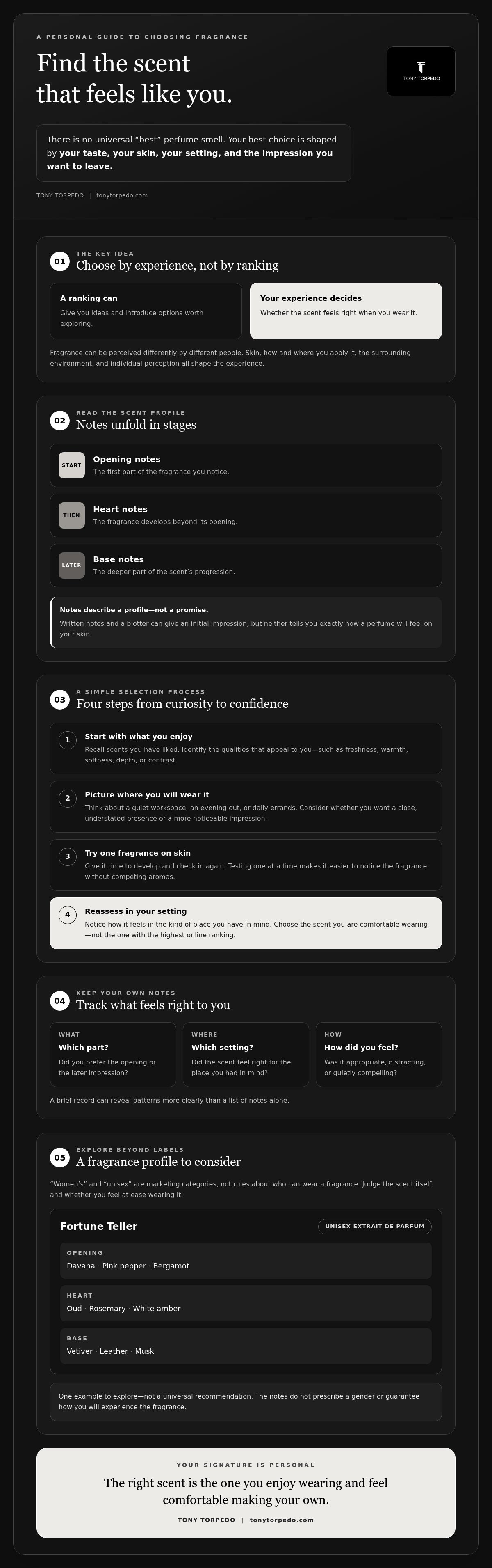
Fragrance notes describe a scent as it unfolds. Opening notes give way to heart notes, then deeper base notes. That structure helps you understand a perfume’s profile, but it doesn’t guarantee that everyone will experience it in the same way. Perfume’s history and composition offer useful context, while labels such as “women’s” and “unisex” are marketing categories, not rules about who can wear a fragrance.
A popular ranking can help you discover options, but your own experience is the measure. Here’s a video with examples often discussed as perfumes for women:
Do perfumes smell different on different people?
They can be perceived differently. Your skin, how and where you apply a fragrance, the surrounding environment, and your individual perception all affect the experience. A blotter gives you an initial impression, while written notes describe expected facets. Neither tells you exactly how the perfume will feel when you wear it.
Perfume preference can’t be universal because scent is experienced through individual perception, personal taste, and context. Try a small amount on your skin, let it settle, then reassess it in a setting where you might wear it. Choose what suits you rather than what a gender label says you should like.
How to Find a Perfume Smell That Suits You
Choose by experience, not by ranking. The search becomes clearer when you identify what you enjoy and check whether that impression holds up in the places you plan to wear the fragrance.
- Start with preference. Think of scents you’ve enjoyed and name what appealed to you: freshness, warmth, softness, depth, or contrast. This gives you a more useful starting point than a broad label such as “floral” or “fresh.”
- Picture the setting. Consider where you’ll wear the fragrance, such as a quiet workspace, an evening out, or daily errands. Decide whether you want a close, understated presence or a more noticeable impression.
- Test one fragrance on skin. Give it time to develop, then check in again before deciding. A first impression is only part of the story.
- Compare how you feel. Choose the scent you’re comfortable wearing, not the one with the highest online ranking.
How should you test a perfume before choosing it?
Try one fragrance on your skin and notice how it changes from its opening to its later impression. Avoid judging several scents at once, because competing aromas can make comparisons harder. If possible, wear the candidate in the kind of setting you have in mind. Does it feel appropriate, distracting, or quietly compelling? Your comfort matters more than its popularity.
Keep a brief note of what you liked and when you liked it. For example, record whether you preferred the opening or the later impression, and whether the scent felt right for the setting. That record can reveal a clearer pattern than a list of notes alone, without prescribing what you should wear based on gender. For a perspective on choosing a defining scent, explore the brand’s single-signature philosophy. For questions about the fragrances, contact TONY TORPEDO.
Choosing a Distinctive Perfume Beyond Gendered “Best” Lists
A distinctive scent begins with the impression you want to create, not a rule about which notes belong to women or men. You might want something that feels bright, grounded, intriguing, or understated. Treat those as personal directions, not fixed formulas. The best perfume smell for woman is the one that feels like a natural expression of you, not a label chosen by a ranking.
Can a unisex perfume be the right choice for a woman?
Yes. A unisex label describes how a fragrance is positioned, not who may wear it. Judge the scent itself: Does its character suit your taste, and do you feel at ease wearing it?
Fortune Teller’s fragrance profile offers one example to explore, not a universal recommendation. It’s a unisex extrait de parfum with davana, pink pepper, and bergamot opening into oud, rosemary, and white amber, followed by vetiver, leather, and musk. Consider how that progression speaks to you, then decide whether it fits the presence you want. The notes don’t prescribe a gender or guarantee how you’ll experience the fragrance.
A signature doesn’t need to be the most praised or the most unusual. It needs to feel considered and genuinely yours. The brand’s single-signature philosophy reflects that focused approach: choose with intention rather than collecting recommendations for their own sake.
For questions about the fragrances, contact TONY TORPEDO.
Choose a Scent That Feels Like Yours
The best perfume smell for woman isn’t decided by a ranking or gender label. It emerges from what you enjoy, how a fragrance unfolds on your skin, and whether it suits the setting and presence you want. Testing thoughtfully gives you a more personal answer than a list ever can.
TONY TORPEDO’s two unisex extrait de parfum signatures, Secret Weapon and Fortune Teller, offer distinct profiles to explore. Secret Weapon pairs bergamot, spice, and coffee with rose, saffron, oud, leather, incense, and musk. Fortune Teller opens with davana, pink pepper, and bergamot, followed by oud, rosemary, white amber, vetiver, leather, and musk. Neither is a universal choice. The right one is the one that resonates with you.
Discover your signature. Contact TONY TORPEDO. Trust your own impression, and choose with confidence.
Frequently Asked Questions
What is the best perfume smell for a woman?
There is no single best perfume smell for a woman, because fragrance preference depends on personal taste, the impression you want, and where you plan to wear it. Treat rankings as starting points, not verdicts. Explore profiles that interest you, then test a candidate on your skin and choose the scent you feel comfortable wearing.
Can a woman wear a unisex perfume?
Yes. “Unisex” is a marketing label, not a rule about who can wear a fragrance. Judge the scent by whether you enjoy its character and feel at ease wearing it. TONY TORPEDO’s Secret Weapon and Fortune Teller are both described as unisex extrait de parfum, offering examples to consider without making either a universal recommendation.
How should I choose a perfume that suits me?
Start by identifying the kinds of scents and impressions you’re drawn to, then consider where you’ll wear the fragrance and how noticeable you want it to feel. Test one candidate on your skin, let it settle, and reassess it in your intended setting. Compare fragrances by your comfort and preference, not by popularity or ranking.


