

What if the mark of niche fragrance brands isn’t obscurity, but a scent with a clear point of view? The word “niche” can signal independence, but on its own, it doesn’t tell you whether a fragrance will feel like you.
A striking story can draw you in. Yet the real test is how a brand’s philosophy, scent profile, and creative choices come together, and how the fragrance settles into your own presence. It’s easy to get lost in long lists and beautiful descriptions. You need better criteria than rarity alone.
This guide shows you how to recognise a considered signature, compare a fragrance’s character with a brand’s philosophy, and choose a scent that feels personal rather than performative. Along the way, Secret Weapon and Fortune Teller offer two focused examples from TONY TORPEDO: distinct compositions, each built as a complete signature.
Key Takeaways
- Assess niche fragrance brands by creative focus, a recognisable scent identity, and a philosophy that feels coherent, not by the label alone.
- Start with notes you’re drawn to, then consider how the opening, heart, and base develop on your skin. Notes are clues, not guarantees.
- Use Secret Weapon and Fortune Teller as contrasting examples: one leans into coffee, rose, saffron, and oud; the other opens with davana, pink pepper, and bergamot.
- Choose a fragrance by the presence you want it to create. A complete signature can stand on its own, without layering.
What Makes Niche Fragrance Brands Distinctive?
Niche describes a brand approach, not a guarantee of quality. Niche fragrance brands often place creative direction and a defined scent identity at the centre of what they make. The distinction is visible in the choices: which notes recur, how the fragrances express a point of view, and whether the brand’s philosophy feels connected to the scents.
“Niche is a category position; quality and personal fit belong to the fragrance itself.” That difference matters. A label can suggest a creative focus, but your nose decides whether the result resonates. For context on the term’s history and use, see What is Niche Perfume?
For a concise look at brands often described as niche, watch this video:
Does niche mean rare, expensive, or simply different?
Not by itself. The word doesn’t prove that a scent is rare, original, or suited to your taste. Nor does a compelling brand story guarantee that you’ll enjoy wearing the fragrance. Look for substance beneath the label: a recognisable creative direction and a clear relationship between the brand’s ideas and its scent profiles.
Limited-quantity production is one specific claim about how much a brand makes. It isn’t the same as a broader creative identity. A brand may communicate its philosophy through a focused selection and a consistent point of view; TONY TORPEDO, for example, describes a single-signature philosophy. Its fragrance philosophy offers one example of how that approach can guide a brand.
How to Evaluate Niche Fragrance Brands Beyond the Label
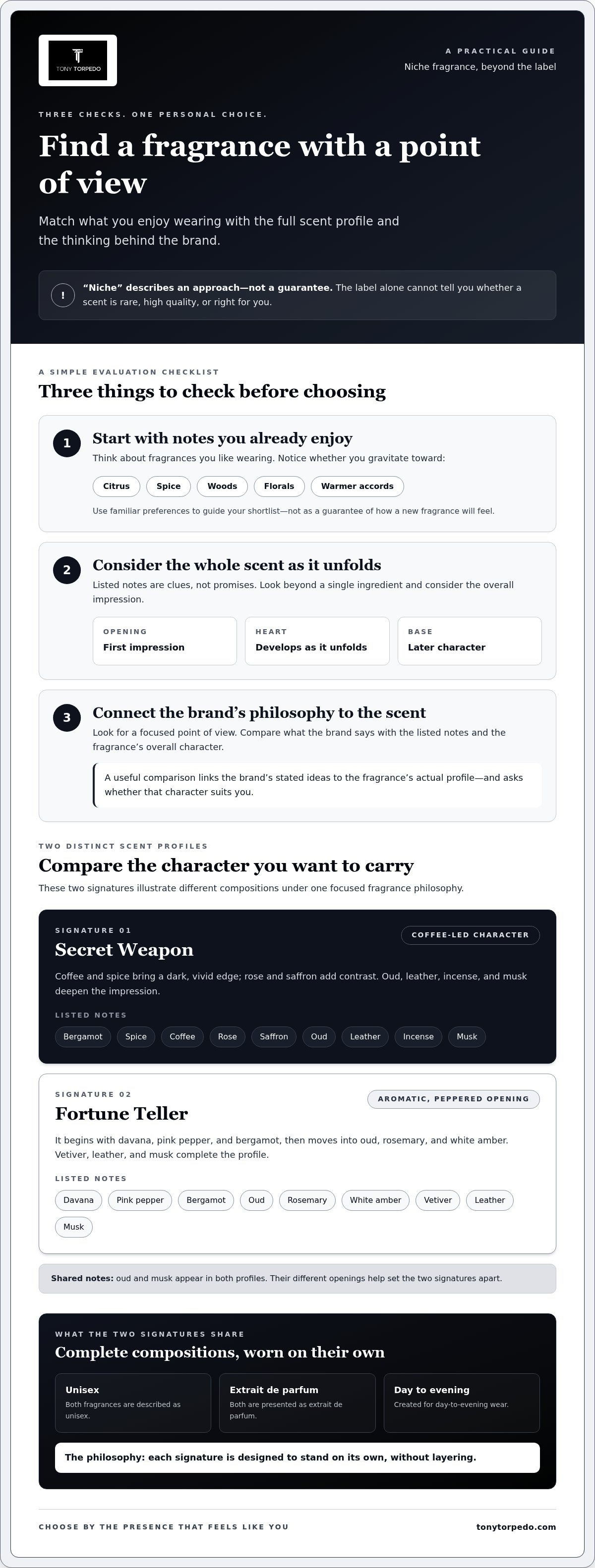
A useful comparison starts with what you enjoy wearing, not with a brand’s claims. Use this three-step framework to bring the choice back to your own taste:
- 1. Identify preferred notes. Think of fragrances you already enjoy. Note whether you’re drawn to citrus, spice, woods, florals, or warmer accords.
- 2. Assess the full profile. Treat listed notes as clues, not promises. The opening is the first impression; the heart develops as the scent unfolds; the base gives the profile its later character. Consider the overall impression, not just one appealing ingredient.
- 3. Consider the philosophy. Look for a point of view that connects the brand’s stated ideas to the scents it creates.
A useful brand comparison links its stated philosophy to the fragrance’s actual profile. If a brand describes a scent as bold, for example, check whether its listed notes and overall character support that impression, then decide whether that character suits you.
What should you compare before choosing a niche fragrance?
Compare each scent with something familiar. If you like bright citrus, bergamot may interest you; if you prefer a deeper impression, consider how woods, leather, or musk shape the full composition. These notes can guide your shortlist, but they can’t predict your personal response on their own.
Then ask whether the brand’s creative direction feels focused, rather than relying on “niche” as a label. Tony Torpedo’s single-signature philosophy is one example of a stated approach to fragrance. For a deeper look at the value question, read “Is Niche Perfume Worth It?”
Take your time with the choice. If you’d like to discuss your preferences, share what you’re drawn to.
Tony Torpedo: Two Signature Scents, One Focused Philosophy
Tony Torpedo offers a focused example of how niche fragrance brands can express a point of view through a small number of distinct scents. Its two signatures, Secret Weapon and Fortune Teller, are designed as complete fragrances rather than as a starting point for layering. The philosophy is deliberate: each composition stands on its own.
Which Tony Torpedo signature matches the presence you want?
Secret Weapon brings bergamot, spice, and coffee into a composition with rose, saffron, oud, leather, incense, and musk. Coffee and spice give its profile a dark, vivid edge, while rose and saffron add contrast. Oud, leather, incense, and musk deepen the impression.
Fortune Teller begins with davana, pink pepper, and bergamot, then moves into oud, rosemary, and white amber, with vetiver, leather, and musk completing its profile. Its aromatic and peppered opening offers a different presence from Secret Weapon’s coffee-led character, while oud and musk provide a point of connection between the two.
Both fragrances are unisex extrait de parfum, created for day-to-evening wear. Compare them by the character you want to carry: Secret Weapon’s spice, coffee, and rose, or Fortune Teller’s davana, pepper, and rosemary. Explore the Fortune Teller fragrance profile for a closer look at its composition. Tony Torpedo’s philosophy is simple: a signature can feel complete without layering.
Notice which profile feels closer to your own presence, then take a moment with the fragrance before deciding. To discuss your signature fragrance, visit Tony Torpedo’s contact page.
Choose a Signature That Feels Like You
The label alone won’t tell you whether a fragrance belongs in your life. Look for a clear creative point of view, use notes to guide your attention, and consider how the full scent profile fits your taste and presence.
Tony Torpedo brings that focused approach to two distinct signatures: Secret Weapon and Fortune Teller, each with a published note profile. Its philosophy is equally direct: one complete scent, worn without layering. The right choice isn’t simply the one with the most intriguing story. It’s the one that feels unmistakably at home on you.
Let curiosity lead. Explore what draws you to niche fragrance brands, then trust your own response to the scent. Discover your signature. Start a conversation and take the next step toward a fragrance that reflects your presence.
Frequently Asked Questions
What makes a fragrance brand niche?
A niche fragrance brand is distinguished by its creative focus and a clear point of view, rather than by a label alone. Look for a recognisable scent identity and a philosophy reflected in the fragrances. Limited production may be part of a brand’s approach, but it doesn’t automatically prove originality, quality, or that a scent will suit you.
Are niche fragrance brands always better than designer brands?
No. “Niche” and “designer” describe different brand positions, not a guaranteed standard of quality. The better fragrance is the one whose character suits your taste and feels right on you. Compare the scent profile, how it develops, and the brand’s creative direction. A compelling story or a rare-sounding label can’t decide personal fit for you.
How do I choose a niche fragrance brand?
Start with notes and scent styles you already enjoy, then assess the full profile rather than choosing by one ingredient. Consider how the opening, heart, and base develop, and whether the brand’s philosophy connects with the fragrance itself. Sampling on your skin can help you judge your response over time. Trust your own impression, not the label alone.
Can a niche fragrance be unisex?
Yes. A fragrance can be marketed as unisex, with its notes and overall character intended for anyone who enjoys wearing it. Tony Torpedo’s Secret Weapon and Fortune Teller are both unisex extrait de parfum. Rather than relying on gender labels to guide your choice, consider the scent’s profile and whether it feels aligned with your taste and presence.


