

Price is a distraction. Quality is a frequency. Most people believe a high price tag guarantees a luxury experience. They're wrong. You've likely felt the sting of a generic designer scent that fades into nothingness within an hour. It's frustrating. It's a betrayal of your presence. Understanding what makes a perfume smell expensive is about decoding the tension between chemistry and art; it's the difference between a loud noise and a resonant chord. You're tired of marketing jargon and fleeting top notes. You want depth. You want a legacy.
True luxury isn't found in a logo. It lives in the rare extractions and the deliberate complexity of the blend. You seek a signature that projects authority without shouting. You want a scent that lingers like a secret. We'll reveal the hidden markers of olfactory wealth. This guide explores the anatomy of presence, from raw material rarity to the psychology of scent. We'll examine why niche icons like Secret Weapon or Fortune Teller command the room. Discover how to identify high-quality profiles and claim a fragrance that finally matches your internal power. The secret is in the details.
Key Takeaways
- Define the distinction. Move beyond mass-market sweetness toward a profile of gravity and intentional tension.
- Identify the markers of rarity. Discover what makes a perfume smell expensive through the use of raw materials that command respect, such as authentic Oud.
- Master the architecture of concentration. Learn why Extrait de Parfum provides the permanence and weight necessary for a lasting legacy.
- Decode the psychology of complexity. Understand why "difficult" notes like smoke and leather signal a refined, intellectual presence.
- Establish your authority. Use high-impact scents to transition from a generic identity to one of absolute influence and foresight.
Beyond the Price Tag: Defining the 'Expensive' Olfactory Profile
Distinction. Presence. Gravity. These are the pillars of olfactory wealth. Many believe a high price tag is the only marker of quality. They're mistaken. Cost is often a mask for mediocrity. True luxury is an internal frequency. It's a choice to stand apart from the noise of the masses. It's about the weight of your choices and the legacy you leave behind.
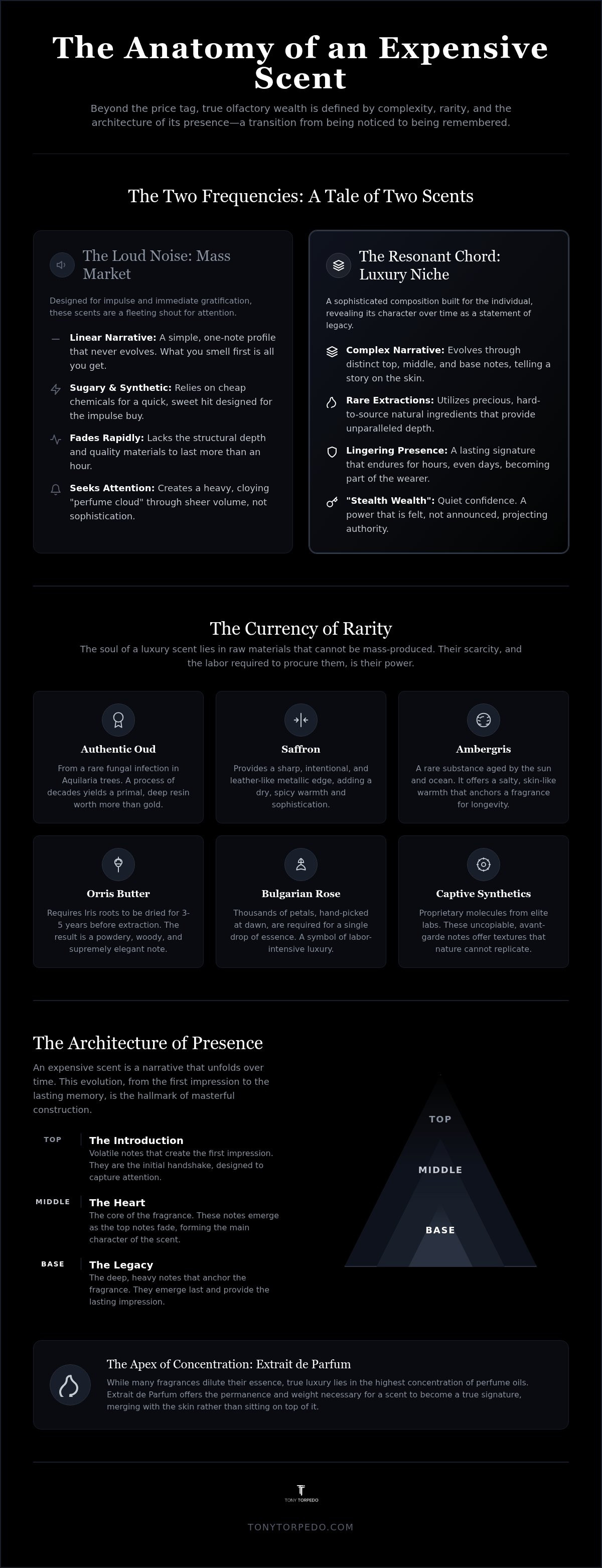
Mass-market scents rely on immediate, sugary gratification. They're designed for the impulse buy. They offer a hit of synthetic sweetness that vanishes as quickly as it arrived. Luxury scents prioritize something deeper. They demand patience. They offer a slow reveal of character. Understanding what makes a perfume smell expensive means recognizing the difference between a loud shout and a resonant whisper. It's the transition from being a consumer to being a connoisseur. It's about finding a scent that feels like a secret only you've been invited to share.
The "expensive" smell is a signature of identity. It isn't a trend. Trends are ephemeral. Identity is permanent. By studying the history and composition of perfume, we see that the most enduring scents were never built for the crowd. They were built for the individual. They were built to endure. They utilize rare extractions that interact with your unique body chemistry to create something entirely singular.
Linear vs. Complex Narratives
Cheap scents are linear. What you smell on the initial spray is the only chapter you'll ever read. There's no depth. No hidden layers. No mystery. This simplicity is the mark of mass production. Expensive scents are a narrative. They evolve on the skin over hours. They possess a top, middle, and base that interact in a constant, shifting dance. Olfactory complexity is the definitive hallmark of luxury. It's the art of telling a story that doesn't end when the sun goes down. It's the difference between a snapshot and a masterpiece.
The Concept of 'Stealth Wealth' in Scent
Avoid the "perfume counter" cloud. That heavy, cloying fog is the signature of the desperate. It seeks attention through volume. Luxury operates through "stealth wealth." It's an understated power. It's achieved through sophisticated blending that feels like a natural extension of the wearer. You don't need to announce your arrival with a chemical trail. What makes a perfume smell expensive is the quiet confidence it projects. This is the difference between being noticed and being remembered. One is a distraction. The other is a legacy. It's about a presence that remains in the room long after you've left it. It's about authority. It's about the impact of a silent partner in your quest for distinction.
Rare Ingredients: The Raw Materials of Distinction
Rarity is the currency of the elite. In the world of scent, some notes are literally worth more than gold. This scarcity is fundamentally what makes a perfume smell expensive. It isn't just about the scent profile. It's about the difficulty of the harvest. It's about the decades required for a tree to produce a specific resin. Mass-market labels can't scale these ingredients. They settle for approximations. You shouldn't.
Consider Oud. Real agarwood is the result of a rare fungal infection within the heartwood of the Aquilaria tree. It's primal. It's deep. It's alive. Synthetic Oud is a flat, chemical echo. It lacks the soul of the original. High-end perfumery also relies on Saffron and Ambergris to create a sense of infinite depth. Saffron provides a leather-like, metallic edge that feels sharp and intentional. Ambergris, aged by the sun and ocean, offers a salty, skin-like warmth that fixates a fragrance for days. These materials don't just smell good. They project authority and a sense of "behind-the-curtain" access.
Master perfumers also utilize "captive" synthetics. These aren't the cheap chemicals found in drugstore bottles. They are proprietary molecules developed over years by elite laboratories. They offer textures and effects that nature cannot replicate. They are the secrets of the industry. This blend of the ancient and the avant-garde defines the modern luxury standard. It's about intentional tension. It's about creating a profile that can't be easily categorized or copied.
The Depth of Natural Extracts
Natural extracts provide the "breath" of a fragrance. Orris butter is a prime example of this dedication. It requires the roots of the Iris plant to be dried for three to five years before extraction can even begin. The result is a powdery, woody elegance that is entirely unmatched by cheaper alternatives. Bulgarian rose requires thousands of petals, hand-picked at dawn, for a single drop of essence. These ingredients are labor-intensive. They are precious. Because they are natural, they react uniquely with your skin chemistry. They evolve. They become personal. If you seek this level of distinction, explore the curated collections at TONY TORPEDO to find your own raw signature.
Exotic Resins and Woods
The foundation of any luxury scent is its base. This is where the story settles. Exotic resins and woods provide the gravity necessary for a signature that commands a room. They are the anchors of identity.
- Sandalwood: Real Mysore sandalwood offers a creamy, milky authority. It's a foundation of quiet strength.
- Incense and Resins: Myrrh and Frankincense provide a provocative mystery. They suggest ancient rituals and hidden knowledge.
- Base Note Anchors: These heavy molecules don't evaporate quickly. They're the reason a luxury scent lingers on a coat for weeks.
These base notes are the architecture of permanence. They anchor the fleeting top notes. They provide the weight required for a lasting impact. Without them, a scent is merely a ghost. With them, it becomes a legacy. It's the difference between a fleeting moment and an era of influence.
The Mastery of Concentration and Evolution
Concentration is the foundation. Blending is the architecture. It's a balance of raw power and delicate restraint. What makes a perfume smell expensive is often the invisible weight of its aromatic oil content. Mass-market brands prioritize the top note to secure the immediate sale. They sell a flash of alcohol and water. Luxury perfumery sells substance. It's a commitment to the enduring impact of the wearer.
Extrait de Parfum represents the pinnacle of this craft. It typically contains between 20% and 40% aromatic compounds. It doesn't merely sit on the skin; it anchors to it. It possesses a physical density. Eau de Parfum is respectable, yet it often lacks this singular gravity. The weight of an expensive scent is felt in its texture. It feels oily, rich, and intentional. It's a promise of permanence that mass production cannot replicate.
The true test of quality occurs at the four-hour mark. This is the dry down. Cheap scents have collapsed by then. They leave behind a flat, metallic residue that smells of desperation. Luxury scents are different. They are just beginning their second act. Luxury perfumes require time to fully reveal themselves because their complex, heavy molecules unfold at varying rates across the day. It's a slow burn. It's a secret that only reveals itself to those who wait.
The Architecture of the Three Tiers
A masterwork is built in chapters. It's a narrative of time and temperature. Each tier serves a specific psychological purpose in the quest for a unique identity. This structure ensures the scent remains dynamic rather than static.
- Top notes: The ephemeral hook. These are the bright, volatile molecules that provide the initial invitation.
- Heart notes: The soul of the fragrance. This is the core character that emerges once the initial flash has faded.
- Base notes: The lasting legacy. These are the heavy hitters that ensure your presence remains long after you've departed.
Sillage and Projection: The Physics of Presence
Presence is not volume. It's resonance. Expensive scents don't shout; they vibrate at a different frequency. The "sillage" is the olfactory trail left in your wake. It's a mark of craftsmanship. It's the ghost of your passage. What makes a perfume smell expensive is this controlled projection. It doesn't overwhelm the room. It intrigues it. It's a steady, intentional pulse rather than a chaotic explosion. It's the difference between being a noise and being a melody. True authority doesn't need to be loud to be felt. It simply needs to be enduring. It's the physics of influence.
The Psychology of Scent: Why Complexity Feels Rich
Scent is a psychological game. It is not about comfort. It is about tension. Most people seek scents that are "nice." They want to be liked. They choose safety. True luxury is provocative. It is the difference between a greeting and an impact. What makes a perfume smell expensive is often its ability to create cognitive dissonance. It is the presence of "difficult" notes. Leather. Smoke. Animalics. These are not inherently pleasant in isolation. Yet, when blended with mastery, they create a sense of intellectual depth. They demand attention. They suggest a wearer who is not afraid to be misunderstood by the masses.
Complexity is the hallmark of the elite. Mass-market offerings rely on cloying sweetness. They hide behind a wall of excessive alcohol. These are "cheap" markers. They are loud but empty. Luxury scents are the opposite. They are a silent statement of authority. There is a direct link between rarity and perceived social status. When you wear a scent that others cannot easily categorize, you possess a secret. You have "behind-the-curtain" access to a different level of quality. It is a declaration of distinction.
This psychological weight is built on the absence of the mundane. You will not find the generic "perfume counter" smell in a high-end bottle. You will find a signature that feels ancient and avant-garde at once. It is about the social weight of your choices. It is about the gravity of your presence. If you're ready to transcend the ordinary and claim a scent that projects absolute influence, experience the provocative power of Secret Weapon at TONY TORPEDO.
Challenging the Nose
Niche perfumes often smell "strange" at first. This is intentional. They are not designed for the impulse buy. They are designed for the connoisseur. Your brain pauses when it encounters a note it cannot immediately name. This pause is where luxury lives. It is the transition from being merely "likable" to becoming "unforgettable." Mastering the art of the unexpected note is the ultimate power move. It requires a discerning mind. It requires a bold tastemaker who understands that what makes a perfume smell expensive is the very thing that makes it challenging. It is a secret language for those who know.
The Memory of Influence
Fragrance is a tool for personal branding. It is your legacy in the air. Luxury scents anchor themselves in the subconscious of everyone you meet. They become your proxy. A unique olfactory signature does not just fade; it resonates. It creates a memory of influence that remains long after you have left the room. This is the lasting impact of quality. It is the difference between a fleeting moment and a permanent impression. Your scent should be as singular as your identity. It should be a mark of authority. It is the ultimate silent partner in your quest for a unique legacy. It is about being remembered for the right reasons.
TONY TORPEDO: Scents of Absolute Influence
TONY TORPEDO is the silent partner in your quest for a unique identity. It's a realm where mystery meets mastery. We don't follow trends. We set a standard for those who wish to stand out from the crowd. What makes a perfume smell expensive at this level is the absolute refusal to compromise on the weight and permanence of the scent. It's about the social impact of your choices. It's about the legacy you leave in the air. This is the behind-the-curtain access to niche quality you've been seeking.
We provide more than just fragrance. We provide a signature. Our collections are curated for the discerning individual who already understands that quality is a non-negotiable requirement. Mass-market retail offers enthusiasm; we offer gravity. Every bottle is a definitive truth. Every spray is an intentional pulse of power. This is where the abstract philosophy of luxury becomes a tangible reality. It is the end of your search for a scent that finally matches your internal authority.
Secret Weapon: The Scent of Influence
Secret Weapon is the pinnacle of influence. It's a profile designed for dominance. It utilizes the dense, resonant notes discussed previously to command immediate respect. This isn't a scent for the timid. It's a signature for the bold tastemaker who understands that what makes a perfume smell expensive is the tension between rare extracts and artistic restraint. It possesses a physical density that anchors to the skin; ensuring your presence is felt long after the initial encounter. It is the ultimate olfactory tool for those who lead. Explore Secret Weapon to witness how raw power translates into olfactory elegance. It is your silent declaration of victory.
Fortune Teller: A Provocative Foresight
Fortune Teller is the scent of provocative foresight. It's complex. It's enigmatic. It captures the essence of a secret yet to be discovered. This fragrance utilizes rare, enigmatic blending to create a narrative that looks forward rather than back. It challenges the nose with unexpected notes that suggest hidden knowledge and ancient rituals. It is the scent of the innovator. The person who sees the path before it is paved. By choosing this profile, you align yourself with a legacy of distinction and intellectual mystery. Discover Fortune Teller and embrace a fragrance that defines the future of your personal brand. It is an uncompromising choice for the unapologetic individual.
The quest for a unique identity ends here. You no longer need to be convinced of quality. You simply need to claim it. TONY TORPEDO is the final word in luxury scents. It is the answer to the unstated need for distinction. Choose your legacy. Command your space. Let the world discover the secret you already know.
Claim Your Olfactory Legacy
Luxury is a choice. It's the refusal to be generic. You now understand the hidden markers of olfactory wealth. It's the tension of rare extractions. It's the deliberate architecture of a slow reveal. Knowing what makes a perfume smell expensive allows you to move beyond the marketing noise. You seek the gravity of authentic Oud and the permanence of high concentration. You value the provocative mystery of a scent that evolves with your identity. It's the difference between a fleeting moment and a lasting era.
This is the standard of the bold tastemaker. It's about personal impact and a lasting legacy. We offer direct-to-consumer exclusivity for those who demand more than mass-market retail. Our signature scents are designed for absolute influence. They are the silent partners in your quest for distinction. Don't settle for a generic top note. Choose a profile that resonates with your internal power. Every spray is a definitive truth. Every scent is a legacy in the making.
Claim your signature scent at TONY TORPEDO. Your presence is your signature. Claim it now.
Frequently Asked Questions
Does a higher price always mean a perfume smells more expensive?
No. Price is a distraction. Quality is a frequency. What makes a perfume smell expensive is the rarity of the extraction and the complexity of the narrative. Many designer bottles inflate cost through marketing. True luxury lives in the weight of the oil. It lives in the evolution of the notes on your skin. You seek substance; not a logo.
What are the specific notes that make a perfume smell 'rich'?
Rare materials define the rich profile. Real Oud, Orris butter, and authentic Ambergris provide a gravity that synthetics cannot mirror. These notes possess a physical density. They interact with your unique chemistry to create a singular signature. Saffron and exotic resins add a sharp, intentional edge. These are the markers of distinction. They suggest a "behind-the-curtain" access to the exceptional.
How can I tell if a perfume has high-quality ingredients before buying?
Study the evolution. High-quality scent is a journey; not a snapshot. If the fragrance remains static for hours, it is likely linear and mass-produced. Observe the dry down. This is the true test of raw materials. Check the concentration level. Extrait de Parfum usually indicates a higher investment in aromatic compounds. Quality is a slow reveal. It demands your patience.
Why do niche perfumes smell different from designer fragrances?
Niche perfumery values the vision over the focus group. Designer scents are engineered for mass appeal. They are safe. They are "likable." Niche icons like Secret Weapon or Fortune Teller embrace provocative notes. They use challenging elements to create cognitive dissonance. This complexity is what makes a perfume smell expensive. It is a definitive choice to stand apart from the crowd.
What is sillage, and why does it matter for luxury scents?
Sillage is the olfactory trail left in your wake. It is the mark of your passage. For luxury scents, sillage is about resonance; not volume. It is a controlled pulse. A cheap fragrance shouts and disappears. A luxury scent vibrates at an enduring frequency. It ensures you are remembered long after you depart. It is the physics of silent authority.
How do I make my perfume smell expensive all day long?
Prioritize pulse points and skin preparation. Apply fragrance to warm areas where blood flow is high. Hydrated skin retains heavy molecules more effectively. Opt for high concentrations like Extrait de Parfum for maximum permanence. Avoid rubbing the application site. This friction destroys the delicate top notes. Let the architecture of the scent unfold at its own pace. Quality is an enduring legacy.
Can synthetic ingredients still smell expensive?
Proprietary synthetics are essential to modern mastery. These are captive molecules; not cheap fillers. They offer textures and sensory effects that nature cannot replicate. They provide the "staccato" of a complex narrative. Master perfumers blend these with rare naturals to create intentional tension. This combination of the ancient and the avant-garde is a hallmark of luxury. It is about sophisticated impact.
What is the 'old money' perfume aesthetic?
It is the aesthetic of "stealth wealth." This profile avoids cloying sweetness and generic florals. It favors understated power and heritage. Think of dry woods, bitter greens, and sophisticated animalics. It projects a sense of permanence and quiet authority. It is a scent that feels like a secret. It is the signature of a bold tastemaker who has nothing to prove.


